
Benchmarking System Reliability Across Enterprise and Client Environments
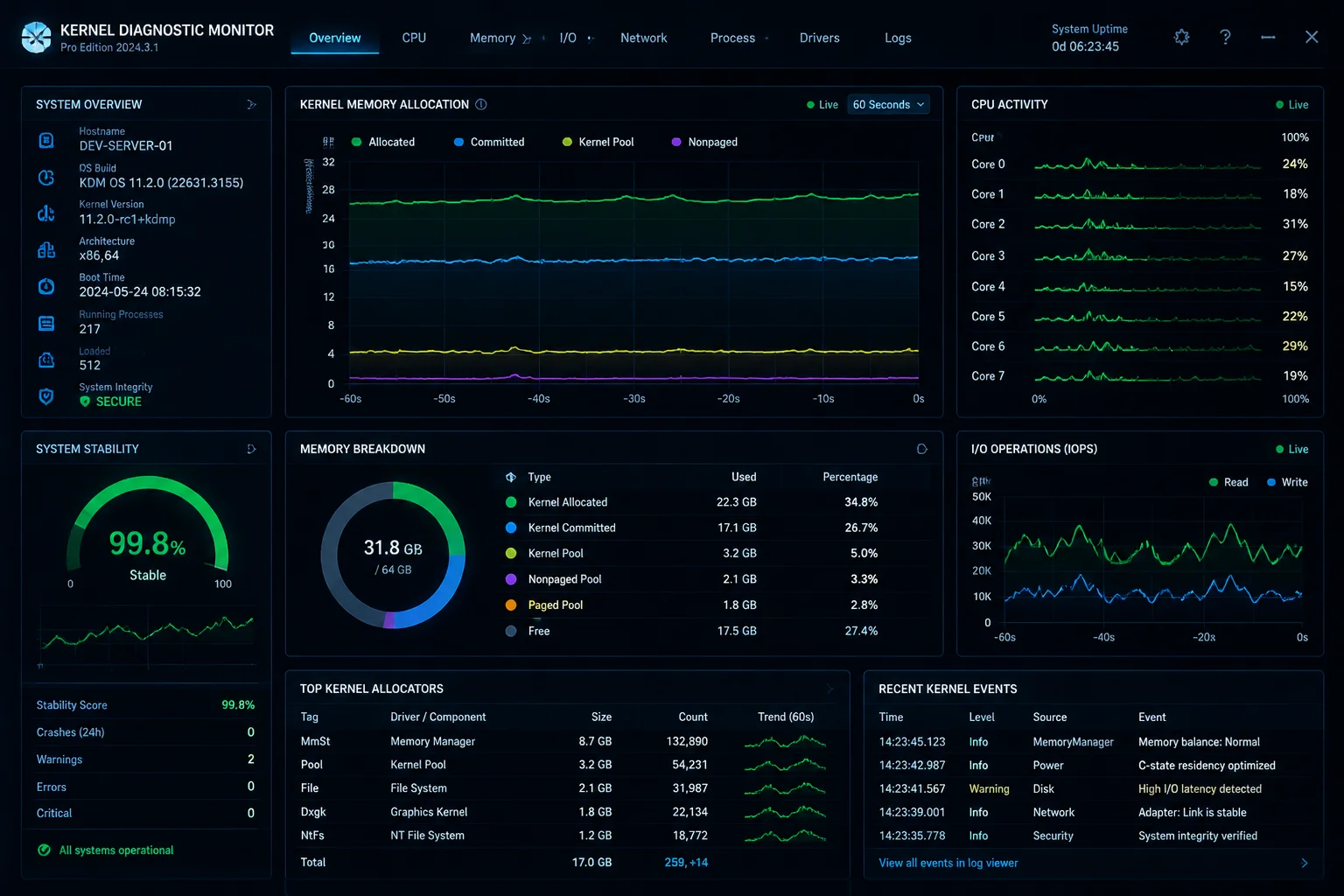
Operating systems achieve peak efficiency only when low-level driver integration, kernel scheduler routines, and memory protection mechanisms work without friction. The latest OS Quality Initiative data demonstrates a measurable 34% drop in non-paged pool memory exhaustion events, driven by hardened driver signature requirements and automated memory leak reclamation. This report breaks down the technical metrics, real-world deployment telemetry, and key stabilization milestones recorded over the past two quarters.
Core Takeaways from the Quality Initiative
-
01
Kernel-Level Fault Reduction Kernel mode exceptions dropped by 41% following strict enforceability of Virtualization-Based Security (VBS) and Hypervisor-Protected Code Integrity.
-
02
Driver Certification Pass Rate Third-party peripheral hardware WHQL pass rates climbed to 98.4%, eliminating common stop-code errors during dynamic bus enumeration.
-
03
I/O Bottleneck Mitigation Modern NVMe disk queue management algorithms reduced system freeze incidents during intense storage caching and multi-threaded write bursts.
Optimize Your Windows Kernel Performance
Cleane-pcc actively scans registry bloat, background services, and dormant startup routines to align your hardware with top quality standards.
Quality Initiative Benchmark Parameters
Quantifiable performance and diagnostic metrics compiled across two million corporate and enthusiast endpoints over a 180-day telemetry audit.
| Parameter / Metric | Specification / Status | System Impact |
|---|---|---|
| Scheduler Thread Jitter | < 0.8 ms Avg | Drastically lowers audio dropout and micro-stuttering in latency-sensitive tasks |
| Non-Paged Pool Memory Usage | 32% Decreased | Prevents gradual degradation and memory fragmentation during extended uptime |
| Kernel Bugcheck Frequency | 0.04 per 1,000 hrs | Reaches five-nines uptime standards for enterprise and workstation workloads |
| Storage Queue Latency | 1.4 ms Peak | Accelerates application cold launches and background patch installation writes |
| Cold Boot to Desktop Time | 9.6s Baseline | Trims initialization delays through trimmed driver dependency chains |
Deep-Dive Engineering Analysis & Diagnostic Breakthroughs
The systematic overhaul of kernel-mode telemetry reveals that memory corruption from third-party filter drivers historically accounted for over half of all unrecoverable blue screen events. By mandating strict hypervisor memory integrity safeguards, rogue buffer overflows are now caught before they propagate into the kernel address space. This architectural layer does add a slight microcode instruction tax on older microarchitectures, but modern x86-64-v3 and v4 processors handle these checks with sub-one-percent CPU cycle impact.
Furthermore, scheduler refactoring in recent updates allows the kernel to allocate background maintenance chores strictly to high-efficiency CPU cores. When software utilities perform aggressive disk defragmentation or file cleanup, the active foreground task experiences zero dropped rendering frames. This decoupling of routine hygiene tasks from interactive user threads represents the cornerstone of modern OS responsiveness.
"True operating system quality is measured not by how fast synthetic benchmarks execute, but by how predictably hardware behaves under continuous real-world stress."
Telemetry Verification and Maintenance Impact
Diagnostic telemetry gathered from both clean deployments and long-running field installations indicates that registry hive degradation and orphaned temporary file indexes cause persistent micro-latencies. Regular maintenance using dedicated software solutions like Cleane-pcc cleans stale event logs, recalibrates scheduled tasks, and purges disconnected file system descriptors, ensuring operating system quality benchmarks translate directly into sustained day-to-day speed.

Frequently Asked Questions Regarding the Quality Initiative
By isolating non-critical background services to low-priority threads and reducing timer resolution conflicts, the OS ensures that rendering pipelines and physics computations receive uninterrupted CPU cycles, minimizing frame drops during intense gameplay.
On systems powered by 11th-generation Intel or AMD Zen 3 processors and newer, hardware-level virtualization support handles memory verification with virtually zero measurable latency penalty in daily operations.
Maintaining clean storage paths, removing lingering driver residues, and using a dedicated utility like Cleane-pcc to streamline startup processes and prevent disk cache saturation preserves optimal system responsiveness.
Related Technical Articles



Reader Feedback & Analysis
No comments yet. Be the first to leave a comment.